
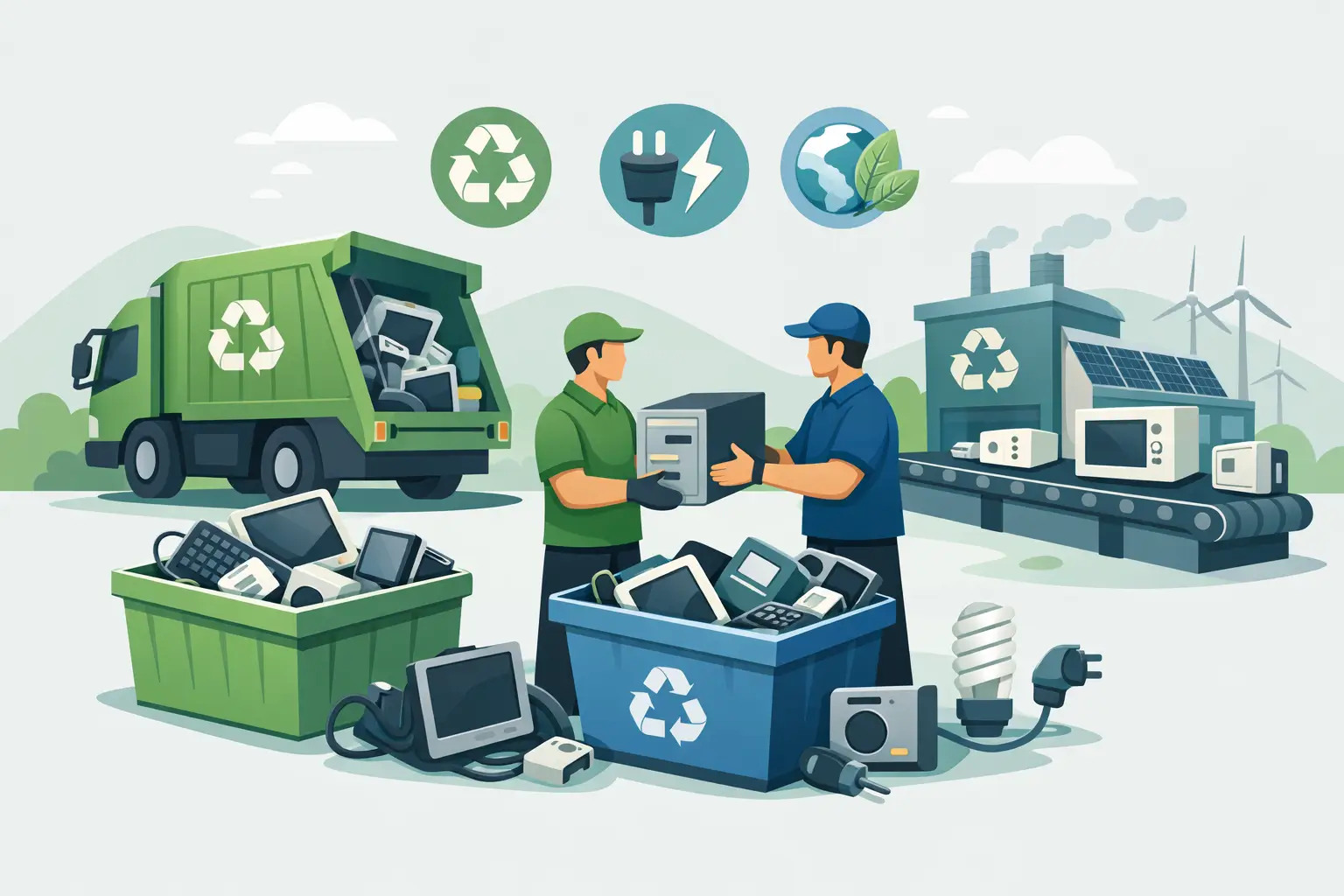
A storeroom full of obsolete laptops, broken monitors and tangled leads is rarely just a space problem. For many organisations, it is a compliance risk, a data security concern and a job that keeps being pushed down the list. That is where an electrical waste recycling service becomes more than a collection booking. It becomes a practical way to remove redundant equipment safely, lawfully and with a clear audit trail.
Electrical waste is often treated as if it all belongs in one pile, but the reality is more complicated. A desktop PC with a hard drive carries very different risks from a damaged kettle in a staff kitchen. Both need responsible handling, yet one also raises questions around confidential information, GDPR and chain of custody. A good service accounts for those differences from the outset rather than treating every item as the same type of waste.
What an electrical waste recycling service should actually do
At its most basic, the service should collect unwanted electrical items and make sure they are processed correctly. In practice, that is only the starting point. Businesses and public sector organisations usually need more than simple removal. They need confidence that waste is handled by a registered operator, moved through approved channels and documented properly.
That matters because electrical waste often falls under WEEE requirements, and disposal decisions can affect both legal compliance and environmental outcomes. If equipment contains storage media, there is also the issue of secure data destruction. If items still have reuse value, sending them straight to material recycling may not be the best result either financially or environmentally.
A well-run service therefore tends to combine logistics, security, compliance and environmental management in one process. Collection should be straightforward. Documentation should be available. Data-bearing devices should be handled under clear procedures. Reusable equipment should be assessed for refurbishment and redeployment before recycling is considered.
Why businesses use an electrical waste recycling service
For many organisations, the main trigger is volume. Old IT builds up quietly – under desks, in comms rooms, in cupboards and at the back of office floors. A relocation, refresh programme or clear-out then turns that slow build-up into an urgent operational issue.
Security is often the bigger driver. Redundant laptops, desktops, servers, mobile phones and removable media can hold sensitive data long after they have fallen out of use. Deleting files or carrying out a quick reset is not the same as certified destruction. If equipment leaves site without proper controls, the risk does not disappear with it.
There is also the question of duty of care. Businesses are expected to take reasonable steps to ensure waste is transferred to authorised parties and managed appropriately. That means disposal is not simply about getting items off-site. It is about knowing where they go next, what happens to them and whether the process stands up if you ever need to prove it.
Compliance, documentation and chain of custody
The strongest electrical waste recycling services reduce uncertainty. That usually starts with formal registrations and clear operating procedures, but it should carry through to every stage of the job.
When electrical waste includes data-bearing assets, chain of custody becomes especially important. You need to know who collected the equipment, how it was recorded, how it was transported and when destruction took place. Certificates and transfer documentation are not paperwork for the sake of it. They provide evidence that the job was carried out correctly.
There is a practical side to this too. Facilities teams, IT managers and office administrators are often coordinating disposal alongside other work. If the provider makes the process complicated, asks the customer to sort everything into obscure categories or cannot explain what paperwork will follow, the service adds friction rather than removing it.
Good providers make the process clear. They explain what they can collect, what needs special handling and what documentation will be issued afterwards. They also avoid overpromising. Some items can be refurbished, some can only be recycled and some may require specialist treatment because of condition or component type. The right answer depends on the equipment.
Reuse first, recycling second
This is where quality varies sharply. A responsible electrical waste recycling service should not treat recycling as the first and only outcome. If equipment can be tested, repaired or refurbished safely, that option usually sits higher in the waste hierarchy.
Reuse has obvious environmental benefits because it keeps functioning products in circulation for longer and reduces demand for new manufacturing. It can also support more ethical outcomes by recovering value from assets that still have useful life left in them. That said, reuse is not always appropriate. Some equipment is too old, damaged or uneconomical to restore. Some organisations also have policies that require certified destruction or disposal of certain assets after use.
The point is not that every item should be reused. It is that every suitable item should at least be assessed properly before being broken down for parts or raw materials. Providers with refurbishment capability can usually deliver a more balanced outcome than those focused only on waste processing.
What to look for in a provider
If you are choosing an electrical waste recycling service, convenience matters, but it should not be the only test. A free collection sounds attractive, and in many cases it is a genuine benefit, especially for organisations clearing larger volumes. Still, value comes from the full service around that collection.
Look for a provider that can explain its compliance position clearly, including relevant registrations and how it handles WEEE streams. If you are disposing of computers, laptops, phones, servers or storage devices, ask how data destruction is carried out and what certification is available. If your site generates mixed electrical waste on an ongoing basis rather than as a one-off clear-out, ask whether on-site container or bin solutions are available to make segregation easier.
It is also worth asking how the provider approaches reuse. A refurbishment-first model is usually a strong sign that environmental performance is being taken seriously. It shows the aim is not simply to move waste fast, but to recover as much value as possible while staying compliant.
For UK organisations that need secure and straightforward disposal, Tech Recycle is one example of a provider built around that model, combining nationwide collections, certified data destruction and a reuse-led approach to redundant IT and electrical equipment.
Common mistakes that create unnecessary risk
The most common mistake is leaving old equipment untouched for too long. Once redundant assets start piling up, stock control becomes weaker, devices go missing more easily and no one is entirely sure what is still on site. A delayed clear-out can turn a manageable task into a larger compliance exercise.
Another mistake is assuming internal wiping is enough for every device. It may be suitable in some cases, depending on your own processes and the sensitivity of the data, but many organisations prefer independent destruction and certification because it reduces ambiguity. The more sensitive the material, the less wise it is to rely on informal methods.
There is also a tendency to focus only on headline cost. Cheap disposal can become expensive if it creates data exposure, poor documentation or environmental failings. The better question is whether the service reduces risk and administrative burden while handling equipment responsibly.
When an ongoing service makes more sense than ad hoc collections
Some organisations only need a one-off collection after an office move or hardware refresh. Others produce a steady stream of redundant equipment throughout the year. In those cases, an ongoing electrical waste recycling service is usually easier to manage than waiting until space runs out.
Regular collections or on-site storage solutions can help keep workspaces clear and maintain better control over outgoing assets. They also make it easier to train staff on where unwanted electricals should go, which reduces the chance of items being misplaced or mixed in with general waste.
This is especially useful in larger offices, schools, healthcare settings and multi-site organisations where electrical waste appears in different departments and at different times. A planned service is not just tidier. It creates a more defensible process.
The right provider should make disposal feel less like a disruption and more like part of normal operations. When collection is simple, data destruction is documented and reusable equipment is given proper consideration, the task stops being a lingering risk in the corner of the office. It becomes a controlled, responsible step that protects your organisation and does right by the equipment you no longer need.