
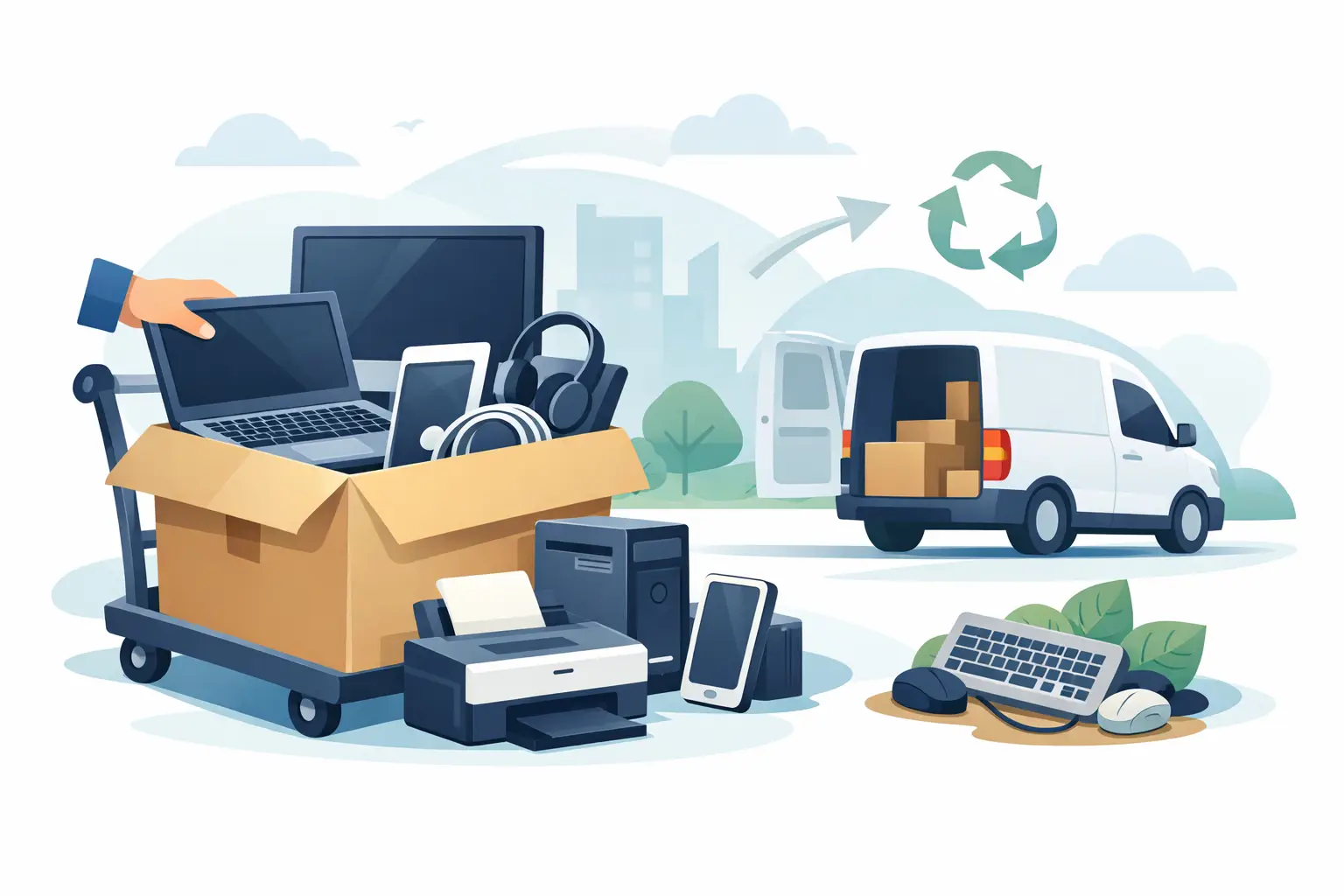
A locked storeroom full of ageing laptops, dusty monitors and retired desktops is more than an inconvenience. For many organisations, it is a data protection risk, a compliance problem and a drain on valuable space. That is why free IT equipment collection matters – it gives businesses, schools and public bodies a practical way to remove redundant assets without adding cost or administrative burden.
The real value is not simply that equipment is collected at no charge. It is that the collection is handled securely, documented properly and aligned with the legal and environmental duties that come with disposing of IT and electrical waste in the UK. If devices may hold sensitive information, or if your organisation needs a clear audit trail, the standard of the service matters just as much as the price.
What free IT equipment collection actually includes
Free IT equipment collection usually refers to a service where qualifying volumes of redundant IT or WEEE equipment are collected from your site without a transport charge. In practice, that can include computers, laptops, monitors, servers, networking equipment, mobile phones, printers, cables and other electrical items, depending on the provider and the volume available.
What separates a professional service from a basic clearance is what happens around the collection. Businesses generally need more than a van and a driver. They need equipment to be booked in properly, moved safely, recorded accurately and processed through secure channels once it leaves the premises. If data-bearing devices are involved, they also need confidence that hard drives, SSDs and other storage media will be destroyed or sanitised in line with recognised standards.
For some customers, free collection is available because the provider can recover value from refurbishment and reuse. That is often a positive sign. A reuse-first approach supports the waste hierarchy by extending the life of equipment where possible before recycling materials that cannot be recovered for further use.
Why businesses choose free IT equipment collection
Most organisations do not delay disposal because they want to. They delay it because it is awkward. Old equipment tends to sit in cupboards, under desks or in secure rooms because no one wants to be responsible for moving it without knowing the compliance position.
A properly managed collection removes that uncertainty. It gives IT teams, facilities managers and office administrators a clear route to clear space, reduce risk and keep records in order. For organisations handling personal data, the security element is often the deciding factor. Even a laptop that no longer powers on can still contain recoverable information, so disposal cannot be treated as a simple skip job.
There is also the environmental side. Sending usable equipment straight to scrap is rarely the best outcome. Where devices can be refurbished, redeployed or broken down responsibly for recycling, the organisation can show that it has taken a more considered approach to waste. That matters to customers, staff, procurement teams and regulators alike.
Free IT equipment collection and compliance
Compliance is where many disposal decisions become more complicated than expected. The moment equipment contains business data or personal information, the risks increase. GDPR does not disappear because a device is old, and WEEE obligations still apply even when the equipment has little obvious resale value.
A compliant collection service should help you manage both sides of the issue. First, there is the environmental handling of waste electrical and electronic equipment. Second, there is the secure treatment of data-bearing assets. These are linked, but they are not identical. A provider may be able to move equipment off-site, yet that does not automatically mean they are set up to manage secure destruction and proper documentation.
This is why registrations and paperwork matter. Environment Agency registration, ICO registration and clear data destruction processes are not small details. They are signs that the service has been designed for real-world business needs, not just basic disposal. If your organisation could be audited, or if you need to demonstrate due diligence internally, those details become essential.
What to check before booking a collection
Not every free collection offer is the same. Some depend on minimum volumes, some only cover specific postcodes, and some are focused on particular equipment types. It is worth confirming the scope before you start moving assets into one pile.
The first question is whether the provider accepts the equipment you need removed. A mixed load of laptops, screens, docking stations and cables may be straightforward, while a collection dominated by low-value or damaged items may need a different arrangement. That does not mean it cannot be collected, only that terms may vary.
The second question is how data destruction is handled. If there are hard drives, solid-state drives, servers, phones or multifunction devices involved, ask what method is used and what certification is supplied afterwards. For many organisations, a certificate of destruction is not optional. It is part of their internal governance.
The third is logistics. Some sites need timed collections, loading assistance or paperwork prepared in advance for reception and security teams. Schools, NHS settings, offices and public sector sites often have practical access requirements that need to be built into the booking.
The process should be simple, not vague
A good collection process should reduce work for your team, not create more of it. In most cases, it starts with a list or estimate of what is ready for collection. That allows the provider to confirm whether the load qualifies for free collection and what vehicle or crew may be needed.
Once booked, equipment is collected from site and transferred into secure processing. Data-bearing items are then destroyed or sanitised under controlled procedures, and the equipment is assessed for refurbishment, reuse or recycling. The best services keep this straightforward. You should know what is happening, what documentation you will receive and who to contact if you need updates.
This is especially important when collections involve larger office clearances, school ICT refreshes or estate-wide asset disposals. The volumes may be greater, but the principle stays the same: secure handling, clear records and responsible downstream processing.
Why reuse matters as much as recycling
Many people use the terms interchangeably, but reuse and recycling are not the same. Recycling is necessary when equipment has reached the end of its life. Reuse comes earlier and is often the better environmental outcome.
If a laptop, desktop or monitor can be refurbished and returned to use, that preserves more value than simply breaking it down into raw materials. It also reduces the demand for newly manufactured equipment. For organisations with environmental targets, this can form part of a stronger sustainability story, provided the process is managed by a specialist that can assess assets properly.
That said, not everything can or should be reused. Some devices are too old, too damaged or too risky from a data security perspective. This is where experienced handling matters. The right decision depends on the condition of the item, the type of data it held and whether safe refurbishment is realistic.
Choosing a provider you can trust
Trust is built on evidence, not claims. If you are comparing collection providers, look for clear compliance credentials, nationwide capability where needed, and a process that covers collection, data destruction and responsible treatment of waste.
It also helps to work with a specialist that understands the pressures on organisations. An office manager may need a quick clearance before a move. An IT manager may need guaranteed data destruction for decommissioned hardware. A school may need old classroom devices collected during a tight term schedule. The service should adapt to those operational realities without losing control of security or documentation.
For UK organisations that want a straightforward route to remove redundant equipment, a specialist such as Tech Recycle can make the process far easier by combining free collections, compliant handling and a reuse-first approach in one service.
When free collection is the right fit
Free IT equipment collection is not just about saving money. It is the right fit when you need to remove redundant devices efficiently, protect sensitive data and show that disposal has been handled properly. For many organisations, that combination matters more than any single line item on a budget.
If your old equipment is sitting on-site because no one wants to take responsibility for what happens next, that is usually the clearest sign to act. The best time to arrange collection is before clutter turns into risk, and before forgotten devices become a problem you have to explain later.
A reliable collection service should leave you with less to worry about, not more. When the process is secure, compliant and genuinely practical, clearing obsolete IT stops being a burden and becomes one job properly dealt with.