
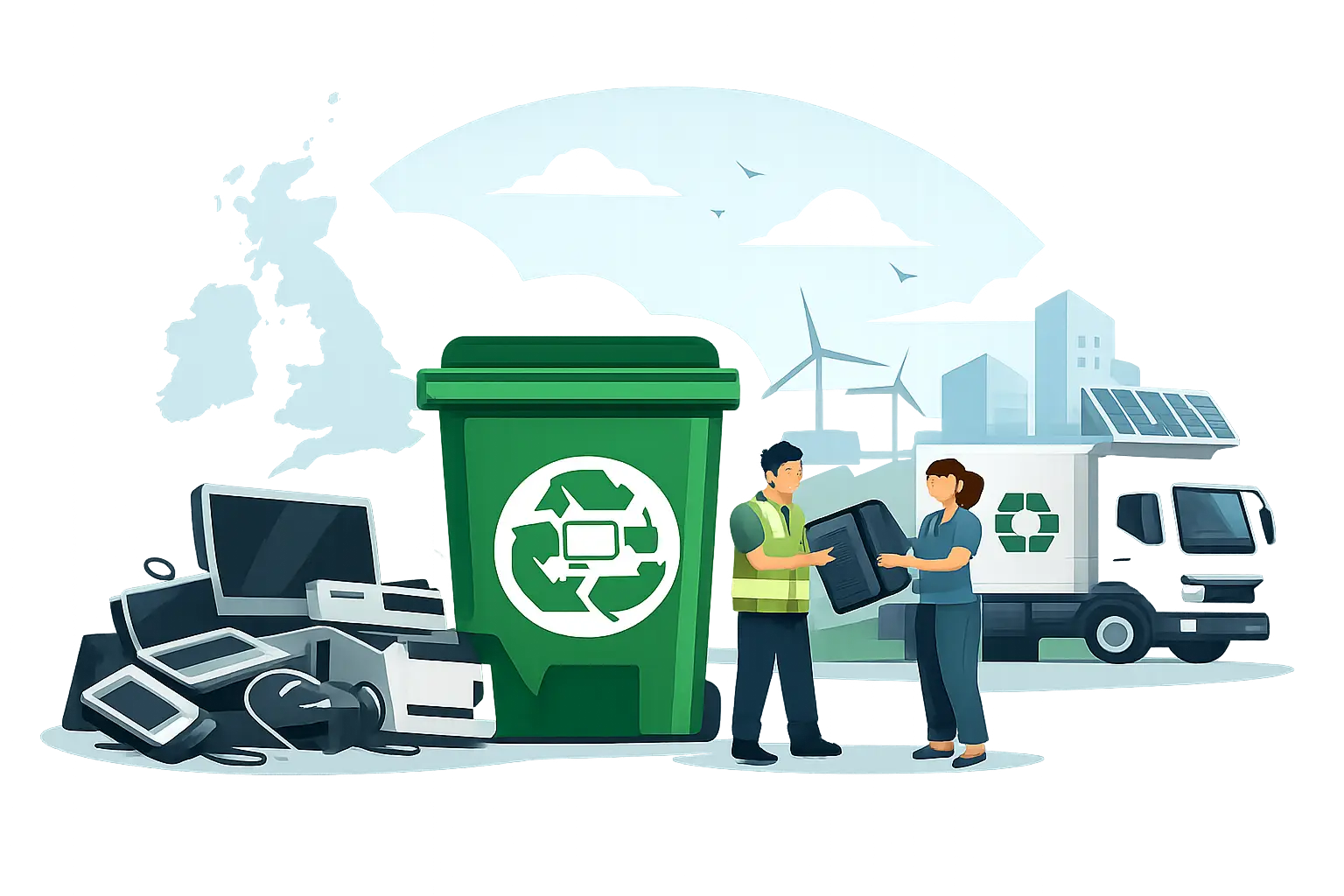
That back room full of old laptops, cracked monitors, dead printers and mystery cables is not just wasted space. For many organisations, it is a compliance risk, a data security risk and a job that keeps getting pushed down the list. WEEE disposal UK requirements are often simpler than people expect, but only if equipment is handled by the right provider and the process is documented properly.
Electrical waste is easy to underestimate because it tends to build up gradually. A desktop here, a few routers there, then a cupboard full of obsolete devices nobody wants to touch because some of them may still hold sensitive data. The practical challenge is not just getting rid of unwanted equipment. It is doing it in a way that protects your organisation, meets legal obligations and avoids unnecessary waste.
What WEEE disposal UK actually covers
WEEE stands for Waste Electrical and Electronic Equipment. In plain terms, it includes most items that need a plug, charger or battery to work. For offices, schools and public sector sites, that usually means computers, laptops, monitors, servers, phones, photocopiers, printers, networking equipment, cables and other electrical assets that have reached the end of their working life.
Some items are straightforward to identify, while others are less obvious. Small IT peripherals, power supplies and mixed electrical items often get left behind because they do not seem significant enough to arrange a collection for. In reality, these smaller items still fall within the same disposal rules and should be managed through an authorised route.
The key point is that WEEE should not be treated like general rubbish. Electrical items contain materials that can be recovered and reused, but they may also contain components that need controlled handling. Proper processing protects the environment and creates a clear audit trail for your records.
Why correct disposal matters more than people think
For most businesses, the first concern is data. If a hard drive sits inside a redundant laptop or server, disposal is not just a waste issue. It becomes an information security issue. Simply passing equipment on, storing it indefinitely or sending it to an unknown collector can create avoidable GDPR exposure.
The second issue is duty of care. Organisations have a responsibility to ensure waste is handled safely and transferred to authorised parties. That matters whether you are clearing a single office, replacing equipment across multiple sites or making room in a school IT store.
Then there is the environmental side. Not every old device should be destroyed. In many cases, secure refurbishment and reuse is the better outcome. It sits higher up the waste hierarchy, avoids unnecessary destruction and reduces demand for new raw materials. That is why a refurbishment-first approach often makes more sense than defaulting straight to shredding or scrapping everything.
Who is responsible for WEEE disposal?
If your organisation holds the equipment, responsibility starts with you. That does not mean you need to become an expert in waste law, but it does mean you should choose a provider that can demonstrate proper registration, controlled processing and clear documentation.
This is where many disposal decisions go wrong. A free collection can sound attractive, but it is only a good option if it is backed by compliant handling and secure downstream processes. Cost matters, of course, especially when dealing with large volumes. But if the service does not include proper records, data destruction where required and responsible recycling routes, the cheap option can become expensive very quickly.
For households, the risk profile is different, but the same principle applies. Personal devices often contain photos, financial records, saved passwords and private messages. A domestic customer may not need the same internal compliance paperwork as a business, but secure disposal still matters.
How to choose a WEEE disposal UK provider
A reliable provider should make the process easier, not more complicated. You should be able to understand what happens from collection through to final treatment, what documents you will receive, and how data-bearing items are secured.
Look for evidence of Environment Agency registration and, where personal data is involved, ICO registration. Ask whether collections are handled directly or subcontracted. Find out what happens to working equipment. If everything is destroyed automatically, that may not reflect best environmental practice. Reuse and refurbishment should be considered wherever possible, provided data is dealt with securely.
It is also worth checking how collections are arranged. Some organisations need a straightforward uplift from one office. Others need site clearances, regular bin-based services for electrical waste, or support for multiple locations. The right service depends on volume, equipment type and how sensitive the assets are.
Secure data destruction and WEEE disposal UK
Data destruction deserves separate attention because it changes the disposal conversation completely. An old monitor is one thing. A laptop with an intact solid-state drive is another.
If you are disposing of computers, laptops, mobile phones, tablets, servers or storage devices, secure erasure or physical destruction should be built into the process. Which option is right depends on the device, the condition of the media and your internal policy. Some organisations require physical destruction for every data-bearing asset. Others are comfortable with certified erasure where reuse is possible.
There is a trade-off here. Physical destruction can feel like the safest route, but it is not always the most sustainable if a device could otherwise be refurbished and redeployed. Certified erasure, when completed properly and documented, can support both compliance and reuse. The right answer depends on the asset, the data sensitivity and your organisation’s risk tolerance.
What should never happen is informal disposal with no proof of what was done. If a provider cannot explain its chain of custody or provide certification, that is a warning sign.
The process should be practical, not disruptive
Most customers are not looking for waste theory. They want the equipment gone, the records in place and the job handled without creating extra work for staff. That is why a good disposal service is built around logistics as much as compliance.
Collection should be straightforward to arrange. Equipment should be inventoried where needed, loaded safely and removed without leaving your team to manage the process alone. For offices with limited storage, a quick turnaround matters. For larger clearances, the provider should be able to plan around site access, health and safety requirements and operational hours.
This matters particularly for schools, NHS settings, local authorities and busy commercial sites. Equipment often accumulates because nobody has time to coordinate its removal. A service that combines collection, secure handling and documentation solves that bottleneck in one step.
Why refurbishment should come before recycling
Recycling has an important role, but it should not be the first answer for every item. If a device can be securely wiped, tested and reused, that is often the better environmental outcome. It extends the life of equipment and reduces the amount of material that needs to be broken down and reprocessed.
That approach also reflects a more responsible view of IT asset disposal. Perfectly usable equipment should not be destroyed simply because it is no longer needed by one organisation. There are limits, of course. Some assets are too old, damaged or uneconomical to refurbish. Others may fail security or performance requirements. But where reuse is possible, it should be considered before recycling.
This is one of the clearest differences between a disposal service focused only on volume and one focused on outcomes. The best providers do not treat every item as scrap by default.
Common mistakes to avoid
The most common mistake is delay. Businesses store old equipment for months or years because disposal feels inconvenient. During that time, data-bearing devices sit unmanaged and valuable space is lost.
The second mistake is mixing WEEE with general clearance jobs. Office moves, refits and storage clear-outs often bring everything together, but electrical waste should still be separated and handled correctly.
The third is failing to document the process. Even if the collection itself goes smoothly, missing paperwork can create problems later, especially if you need proof of destruction or evidence of compliant transfer.
Finally, do not assume every collector offers the same standard of service. There is a real difference between basic removal and a specialist service built around secure chain of custody, certified destruction and ethical reuse.
A more straightforward way to deal with electrical waste
For most organisations, the best WEEE process is the one that removes friction. You need a provider that can collect nationally, handle sensitive equipment securely, supply the right paperwork and prioritise reuse before recycling wherever possible. That is the model Tech Recycle is built around, because disposal should solve a problem, not create a new one.
If you are looking at a pile of redundant IT and electrical items and wondering whether to leave it for another quarter, it is usually better to act now. The right disposal route clears space, reduces risk and puts equipment back into the right system – whether that means secure reuse, recycling or certified destruction. A tidy storeroom is useful, but peace of mind is better.