
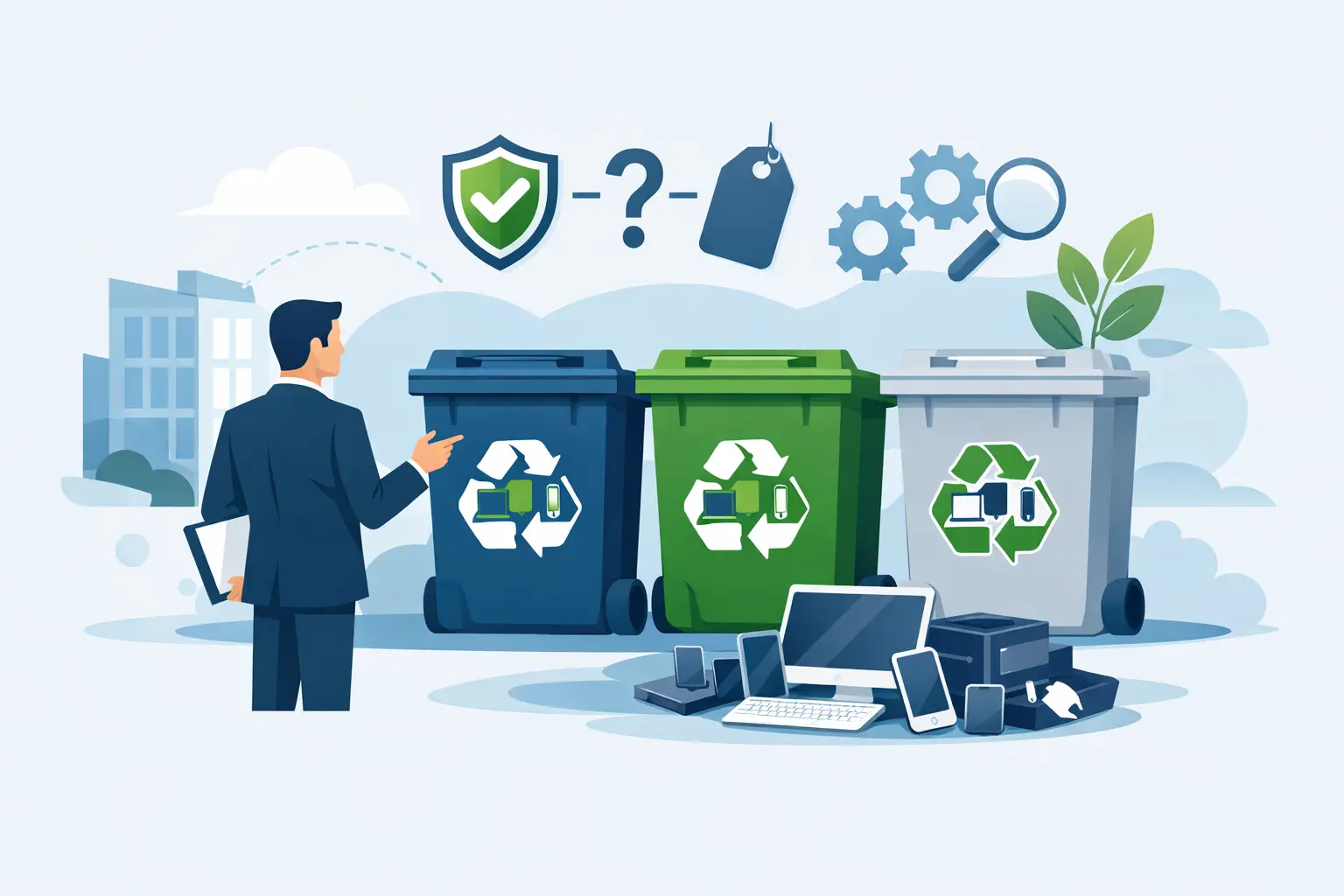
A full storeroom is rarely just a space problem. In most organisations, it is also a compliance risk, a data risk and a sign that redundant electrical items are not moving through the business properly. A reliable business WEEE bin service helps solve all three at once, provided it is designed for secure handling, clear documentation and responsible treatment of equipment after collection.
For many businesses, the challenge starts small. A few broken monitors under desks, a cupboard of old keyboards, a stack of obsolete laptops waiting for a decision. Then an office move, an IT refresh or a clear-out turns that low-level backlog into a practical headache. At that point, a bin service is not simply about getting waste off site. It is about making sure the right material is separated, collected safely and dealt with in line with the Waste Electrical and Electronic Equipment regulations, data protection duties and internal ESG expectations.
What a business WEEE bin service should actually do
A business WEEE bin service should do more than drop off a container and collect it when full. For offices, schools, public sector sites and commercial premises, the service needs to fit how electrical waste is generated in the real world. That means straightforward storage on site, dependable collection arrangements and a process that distinguishes between general electrical waste and equipment that may still contain data.
This distinction matters. A broken kettle in a staff kitchen and a retired desktop computer may both fall within WEEE streams, but they do not carry the same security implications. If a provider treats every item as simple mixed waste, the customer ends up carrying unnecessary risk. A sound service recognises that some items need secure collection routes, serial number recording, data destruction and certificates, while others can move straight into standard WEEE processing.
There is also an environmental question. Not every redundant item should be destroyed. If equipment can be tested, refurbished or reused, that is usually a better outcome than immediate recycling. Businesses increasingly want proof that their disposal partner is following the waste hierarchy rather than taking the fastest route to scrap value.
Why compliance matters in business WEEE bin service decisions
Compliance is often treated as paperwork at the end of the job, but that misses the point. The value of a business WEEE bin service lies in the chain of custody from the moment an item is placed in the bin or collected from site. If that chain is vague, the documents at the end do not mean much.
For UK organisations, the basics are clear enough. Electrical waste must be handled by an authorised provider, moved with proper waste transfer documentation and processed at approved facilities. Where IT assets are involved, data protection obligations sit alongside waste duties. If hard drives, laptops, servers or mobile devices leave the premises without secure controls, the disposal issue quickly becomes a governance issue.
That is why buyers should look beyond a simple promise of collection. Ask how equipment is segregated. Ask what happens to data-bearing devices. Ask whether certificates of destruction and transfer notes are provided. Ask whether the provider holds the relevant registrations and operates in a way that would stand up to internal audit scrutiny. A service that feels slightly vague at quotation stage usually becomes more vague after collection.
On-site bins are useful, but only if the setup is practical
An on-site WEEE bin can be an excellent solution for organisations generating a steady flow of small electrical waste. It gives staff somewhere obvious to place cables, peripherals, small appliances and similar items instead of leaving them in cupboards or adding them to general waste by mistake. That simple change improves housekeeping and reduces the chance of non-compliant disposal.
But practicality matters. The wrong bin size, poor positioning or unclear rules about what can go in it can create fresh problems. A bin placed in a loading area may suit facilities teams but be ignored by office staff. A bin for mixed electrical waste may become unsuitable if people start dropping in phones or laptops containing data. In some settings, a locked container or a clearly separated stream for data-bearing devices is the safer option.
It also depends on volume. Some organisations benefit from a permanent service because they generate WEEE every week. Others only need temporary support during a refresh project or office move. The best arrangement is the one that matches how your site actually operates, not the one that looks neat on paper.
What happens after collection matters as much as collection itself
Collection is the visible part of the service, but downstream treatment is where standards are really tested. Once electrical waste leaves your premises, it should enter a controlled process that prioritises reuse where possible and recycling where necessary.
That approach is not only better for the environment. It is often the strongest sign that a provider understands the value and sensitivity of business equipment. Devices and components that can be refurbished or redeployed should not be needlessly destroyed. Equally, items that are damaged beyond reuse still need proper dismantling and material recovery to avoid environmental harm.
For businesses under pressure to show measurable sustainability outcomes, this part of the process is increasingly important. A provider that can explain how items are assessed, what is refurbished, what is recycled and how hazardous elements are managed will usually offer more reassurance than one that talks only about clearances and collections. Responsible treatment is not an add-on. It is the point of the service.
Choosing a business WEEE bin service for IT-heavy sites
IT-heavy sites need a more careful model than general premises. If your organisation regularly retires desktops, laptops, monitors, docking stations, networking kit or mobile devices, then the business WEEE bin service must support both waste management and asset security.
In these environments, speed matters, but control matters more. Equipment should not sit unrecorded in open bins for weeks. There should be a clear route for staff to separate ordinary electrical waste from devices containing storage media. Depending on the site, that might mean a scheduled collection service, secure cages, lockable bins or direct collection from an IT room.
Documentation also becomes more important as volume rises. Facilities teams may care most about space and access. IT teams may focus on serialised assets and data destruction. Compliance leads may want auditable evidence that the process meets legal and policy requirements. A capable provider should be able to serve all three priorities without turning a simple collection into an administrative burden.
This is where service design counts. Tech Recycle, for example, centres its approach on secure collection, certified destruction where needed and reuse before recycling wherever possible. That balance reflects what many organisations now expect: simple disposal on the surface, backed by a controlled process behind it.
Common mistakes businesses make
The most common mistake is assuming all electrical waste can be handled the same way. It cannot. Small appliances, display equipment and data-bearing devices may all enter the wider WEEE stream, but they require different controls.
Another frequent issue is delay. Businesses hold onto obsolete equipment because they intend to deal with it later, then end up with stockpiles that are harder to assess and riskier to manage. The longer redundant kit sits in cupboards, the easier it is to lose track of what it contains and whether it should have been securely processed months earlier.
There is also the temptation to choose on convenience alone. A fast collection with little questioning can sound attractive, but if there is no clarity on authorisation, documentation or downstream handling, the convenience is superficial. A proper service should make the job easier while still being exact about compliance.
How to judge whether a provider is right for your organisation
Start with the basics: authorisation, documentation and security. If those are weak, the rest does not matter much. Then look at operational fit. Can the provider support your site layout, access restrictions and collection volumes? Can they manage both ad hoc clearances and ongoing bin services if your needs change?
After that, look at environmental intent. Do they talk only about disposal, or do they show a clear preference for refurbishment and reuse where appropriate? For many organisations, this is no longer a secondary issue. Procurement teams, school leaders, office managers and public sector buyers are all under greater pressure to reduce waste and show responsible outcomes.
Finally, consider how easy the service is to use. A good provider removes friction. Staff know what goes where. Collections happen when expected. Paperwork arrives promptly. Questions are answered clearly. That may sound basic, but in practice it is often what separates a dependable service from one that creates more work than it saves.
A business WEEE bin service should leave your site clearer, your records stronger and your risks lower. If it also helps more equipment stay in use for longer, that is a better result for your organisation and for the wider environment.