
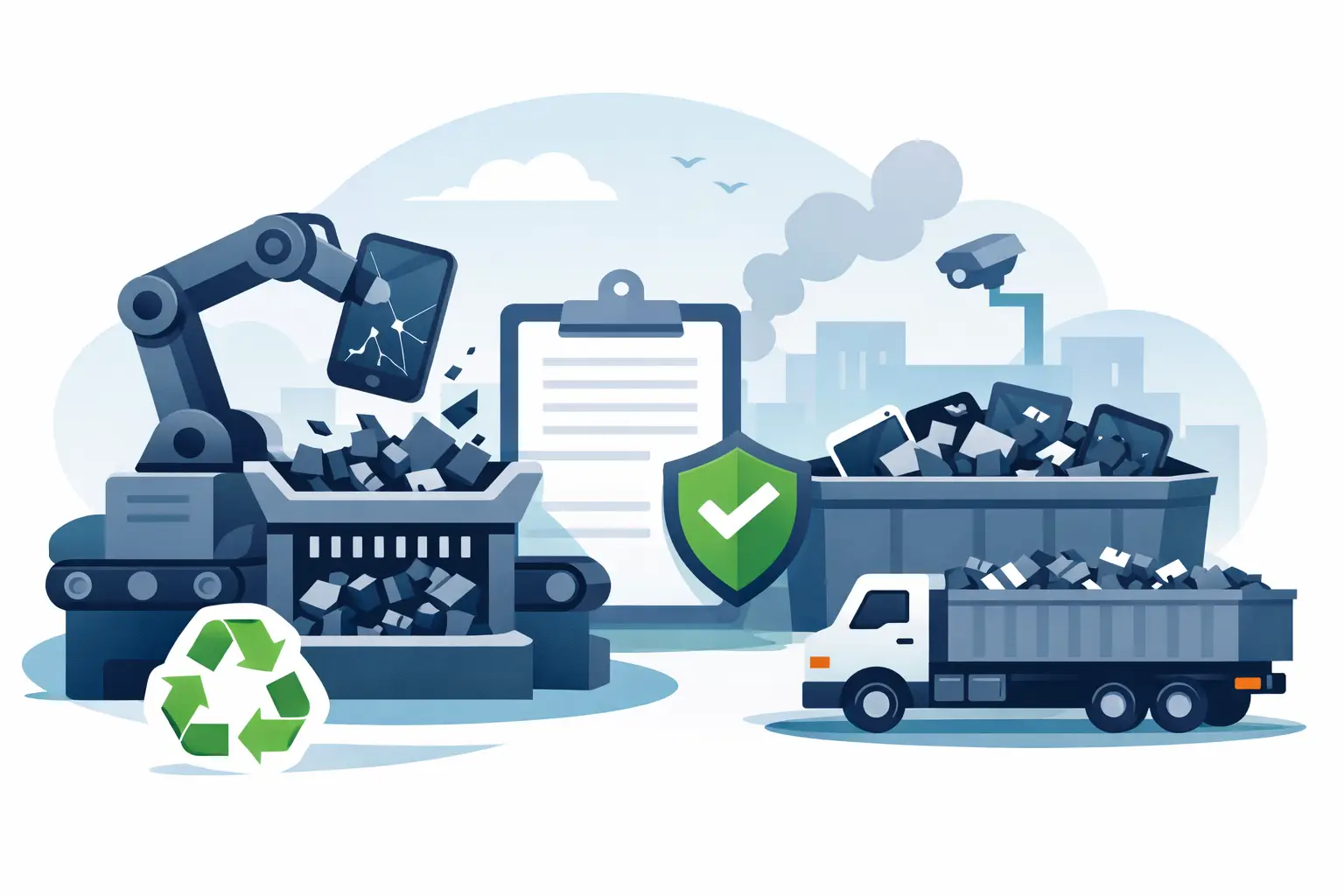
A drawer full of old handsets can look harmless until someone asks where the data went. For businesses, schools and public bodies, that is where certified mobile phone destruction matters. It is not simply about breaking a device beyond use. It is about proving that phones containing personal, commercial or operational data have been handled securely, in line with legal duties, and disposed of through a documented process.
Mobile phones hold far more than call logs and contacts. They often contain emails, saved passwords, multi-factor authentication access, business messaging, location history, photographs, documents and app data linked to wider systems. Even when a device is switched off or no longer in service, that information can remain recoverable if the handset is passed on, stored carelessly or disposed of through the wrong channel.
What certified mobile phone destruction actually means
Certified mobile phone destruction is a controlled disposal process backed by documentation. The certification is the key part. It gives the organisation disposing of the phones evidence that the devices were received, tracked, processed and destroyed in a compliant manner.
That usually includes an audit trail, asset recording, secure handling and a certificate confirming destruction has taken place. For many organisations, that paperwork is just as important as the physical act itself. If a compliance lead, auditor or insurer asks what happened to redundant devices, a clear record matters.
The exact process can vary depending on the provider and the type of phone involved. Some organisations also need serial number reporting or batch-level asset lists. Others need on-site handling because the devices cannot leave the premises intact. The right approach depends on the sensitivity of the data, internal policy and the volume involved.
Why destruction is not always the first option
Secure destruction has a clear place, but it should not be the default for every handset. Wherever possible, reuse and refurbishment are usually the better outcome. That fits the waste hierarchy and avoids destroying equipment unnecessarily.
If a phone can be securely data wiped, tested and prepared for redeployment or resale, that is often the more responsible route. It reduces waste, supports the circular economy and can preserve value in the asset. Destruction becomes the right option when a handset is damaged, unsupported, non-functional, too old to redeploy safely, or when the data risk means reuse is not appropriate.
This is where an experienced recycling partner adds real value. A good provider does not treat destruction as the answer to everything. They assess whether the device can be reused first, then move to destruction only where that is necessary for security, compliance or practical reasons.
When certified mobile phone destruction makes sense
There are several common situations where destruction is justified. One is when devices have been used by senior staff, finance teams, HR teams or anyone handling high-risk personal or commercial data. Another is when handsets are physically damaged and cannot be reliably wiped or refurbished.
It also makes sense during office clear-outs, school IT refreshes and bulk collections of mixed obsolete technology, where old mobile phones have been sitting in storage for months or years. In those cases, the longer they sit unaccounted for, the greater the data protection risk.
Some sectors are stricter than others. Healthcare, education, legal services, local authorities and financial organisations often need stronger evidence of disposal because of the nature of the information involved. For them, a documented destruction process is often the most straightforward way to reduce risk.
Compliance, GDPR and the need for proof
Under UK GDPR and the Data Protection Act, organisations are expected to protect personal data throughout its lifecycle, including when equipment reaches end of use. That does not mean every phone must be shredded, but it does mean disposal must be secure, appropriate and defensible.
If a phone is lost, stolen or recovered with data still on it, the issue is not only operational embarrassment. It can become a reportable data breach, with legal, financial and reputational consequences. That is why informal disposal routes are risky. Passing phones to staff without controls, leaving them in general WEEE bins or sending them to unverified buyers can create avoidable exposure.
Certification helps close that gap. It shows that devices were not simply removed, but processed through a managed chain of custody. For many organisations, that turns a vague internal assurance into documented evidence.
What a secure process should include
A reliable mobile phone destruction service should start with secure collection and clear intake procedures. Devices should be tracked from the point of collection, with handling designed to reduce the risk of loss or tampering in transit.
Once received, the phones should be assessed. If reuse is possible and appropriate, secure data erasure may be the better route. If destruction is required, the handsets should move into a controlled destruction stream. The provider should then issue confirmation of destruction, and where agreed, supporting asset reports.
It is worth asking practical questions before choosing a supplier. Do they provide clear documentation? Are they properly registered? Do they understand GDPR-related disposal requirements? Can they manage other IT and electrical waste at the same time? Those details often tell you more than broad claims about security.
A service that combines collection, data handling and compliant recycling can also reduce internal workload. Facilities teams and office managers rarely want to coordinate multiple contractors for phones, laptops, cables and other redundant electrical items if one specialist can handle the lot.
The environmental side of mobile phone disposal
Phones are small, but their environmental footprint is not. They contain plastics, metals and components that should be recovered through proper recycling channels when reuse is no longer possible. Throwing them away with general waste is the worst of both worlds – poor data security and poor environmental practice.
There is also a wider point here. Responsible disposal is not only about end-of-life treatment. It is about making sure destruction is used carefully, not casually. A refurbishment-first approach supports better environmental outcomes because it keeps equipment in use for longer and reduces the demand for new manufacturing.
That is particularly relevant for organisations with ESG goals or internal sustainability targets. If you can show that devices were assessed for reuse first and destroyed only where necessary, your disposal process stands up better to internal scrutiny.
Choosing a provider for certified mobile phone destruction
Not all disposal services offer the same level of control or transparency. For mobile phones, that matters because the devices are portable, easy to misplace and rich in sensitive data.
Look for a provider that can explain its process plainly and back it up with documentation. Environment Agency and ICO registration are relevant indicators in the UK. So is experience in handling business IT assets and confidential waste. The strongest providers make the process straightforward without cutting corners.
It is also sensible to consider the broader service model. If a provider offers nationwide collection, clear reporting and support across WEEE and IT disposal, that can simplify ongoing asset management. For organisations dealing with regular device refreshes, the easiest service is often the one that removes clutter, protects data and keeps paperwork in order with minimal effort from internal teams.
Tech Recycle takes that practical view. Where a handset can be reused safely, reuse should come first. Where it cannot, secure destruction and certification provide a clear, compliant route that protects both the organisation and the environment.
A practical decision, not a box-ticking exercise
The reason certified mobile phone destruction matters is simple. Old phones do not stop being a risk just because nobody is using them. They remain data-bearing assets until they have been securely wiped, refurbished, recycled or destroyed through a controlled process.
For some organisations, that will mean destruction for every redundant handset. For others, it will mean a mixed approach based on condition, data sensitivity and reuse potential. The sensible option is the one that balances security, compliance and environmental responsibility without creating more work than it solves.
If you are looking at a pile of obsolete phones and wondering whether they should be stored, wiped, reused or destroyed, start with the question that matters most: can you prove they have been handled properly when they leave your hands?