
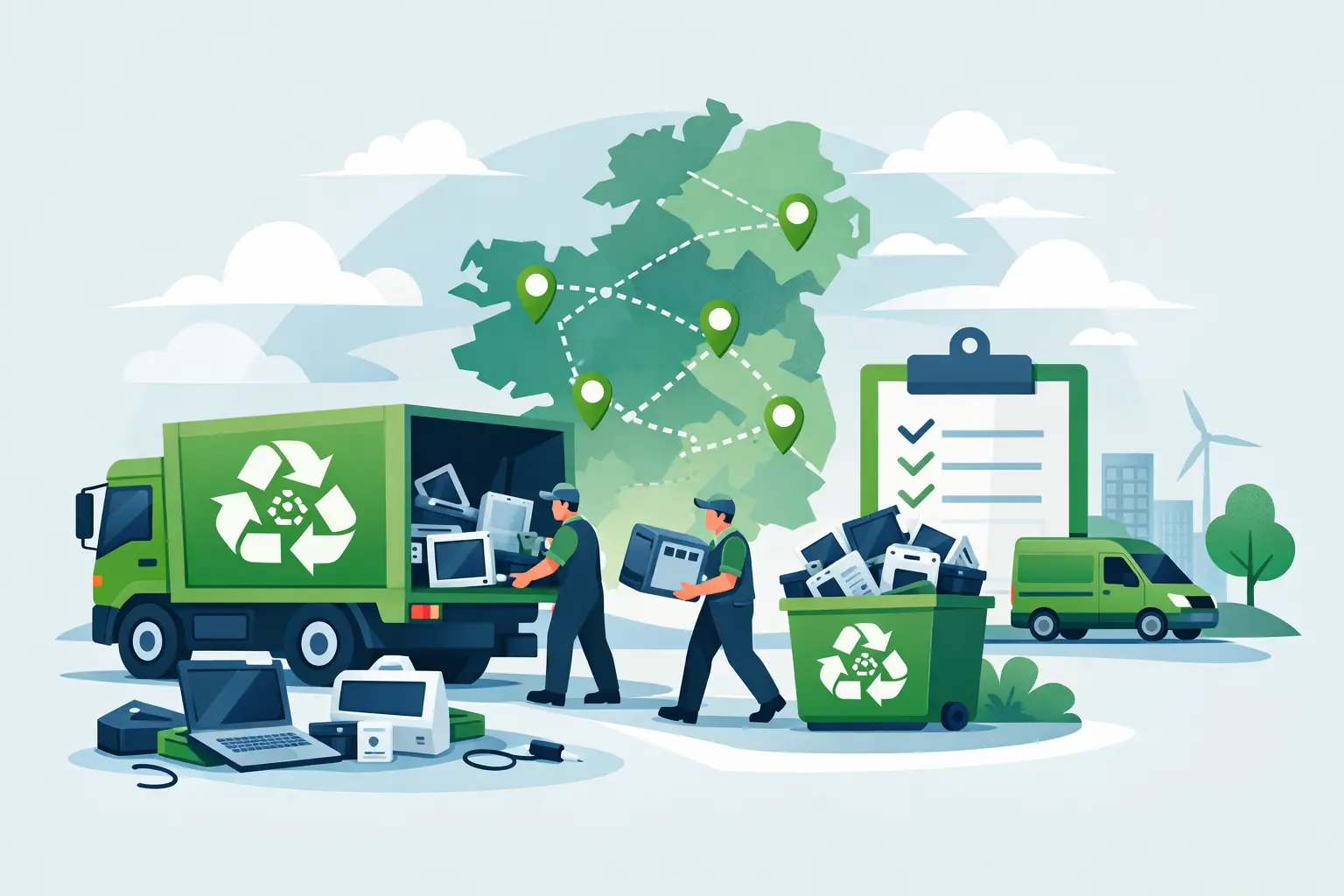
A locked cupboard full of old laptops is rarely just a space problem. For many organisations, it is also a data protection risk, a compliance issue and a delay to doing the right thing with equipment that could still hold value. That is why free WEEE collection nationwide matters – not as a marketing extra, but as a practical way to remove redundant IT and electrical waste safely, legally and without adding cost to an already busy team.
For office managers, IT teams, schools and facilities leads, the real question is not simply who can take unwanted equipment away. It is whether the collection service protects sensitive data, provides the right paperwork and handles items in line with the waste hierarchy. A free collection only has value if the process behind it is secure and properly managed.
What free WEEE collection nationwide should actually include
WEEE stands for Waste Electrical and Electronic Equipment. In practice, that covers a wide range of business items, from desktop computers, laptops and monitors to printers, phones, servers, networking kit, cables and other electrical equipment that has reached the end of its working life.
A proper free WEEE collection nationwide service should do more than load equipment into a van. It should give you a clear route from collection to final treatment, with secure handling at every stage. For organisations holding devices that may contain personal data or commercially sensitive information, that chain of custody matters just as much as the removal itself.
The strongest services are built around three outcomes. First, they make disposal easy by arranging collection from your site. Second, they reduce risk through secure data destruction and supporting documentation. Third, they prioritise refurbishment and reuse where possible, rather than defaulting to destruction.
That final point deserves attention. Destroying equipment is sometimes necessary, especially where assets are damaged beyond recovery or where specific destruction instructions apply. But when a device can be securely wiped, tested and refurbished, reuse is often the more responsible result. It avoids unnecessary waste and supports a more circular approach to IT asset disposal.
Why businesses look for free WEEE collection nationwide
Most organisations do not search for this service because they suddenly become interested in recycling policy. They search because old equipment starts to build up, offices change layout, devices are replaced in batches, or an audit highlights assets that should have been removed months ago.
There is usually a mix of pressures behind the decision. Storage space is being lost to obsolete kit. Internal teams do not want the burden of arranging multiple disposal routes. Finance wants a sensible, cost-conscious option. Compliance teams want assurance that data-bearing equipment is handled correctly. Senior management wants a process that does not create reputational risk.
Free collection helps because it removes one of the biggest barriers to action. When a service can collect qualifying volumes without charging for the uplift, equipment is less likely to sit forgotten in a back office or storeroom. That benefits both the organisation and the wider environment, especially when collected assets can be refurbished or separated properly for recycling.
Still, free does not mean identical. The detail matters. Some providers focus only on transport. Others offer a much broader managed service, including asset tracking, secure destruction, consignment documentation and evidence of compliant processing. If you are comparing options, that difference is where most of the real value sits.
Compliance, data security and why paperwork matters
Any organisation disposing of IT equipment needs to think beyond convenience. Computers, hard drives, laptops, mobile devices and multifunction printers may all hold data. Even where a device looks inactive or outdated, stored information can remain recoverable if it has not been properly destroyed or sanitised.
That is where a compliance-led provider earns trust. Secure collection procedures, GDPR-aware handling and formal certification are not administrative extras. They help show that your organisation has taken reasonable steps to protect information throughout the disposal process.
If you work in education, healthcare, professional services or the public sector, this is even more important. Devices may contain staff records, student information, customer files, financial data or internal documents. Leaving those assets unmanaged creates unnecessary exposure.
You should expect clarity on what happens after collection. Will the provider issue documentation for data destruction? Are they registered appropriately for waste handling and information governance? Can they explain how assets are processed, whether through reuse, component recovery or compliant recycling? A good service answers these questions plainly.
Free collection is useful – but suitability depends on volume and type
Not every collection request will look the same, and that is worth being honest about. In many cases, free collections are offered for qualifying loads or equipment types, particularly where there is enough recoverable value in the material stream to support the logistics. A business replacing twenty laptops and a batch of monitors may be straightforward to collect at no charge. A single low-value appliance in a remote location may be a different case.
That does not make the service less genuine. It simply reflects how responsible waste operations work in practice. Collection vehicles, staff time, secure handling and downstream processing all carry a cost. Providers offering free uplift usually do so as part of a service model built around volume, reuse potential and efficient routing.
For customers, the key is transparency. A trustworthy recycler will explain whether your load qualifies, what can be accepted and whether any specialist items need separate handling. That is far better than vague promises followed by confusion on collection day.
What a well-run collection process looks like
A reliable service should feel straightforward from the start. You describe the equipment you need removed, the provider confirms whether it qualifies for collection, and a date is arranged. If data-bearing items are involved, the handling requirements should be clear before anything leaves site.
On the day, equipment is collected by trained operatives and moved into a controlled process. Depending on the service, this may include itemised reporting, data destruction, shredding of storage media or testing for refurbishment. What matters is that there is an accountable route from your premises to final outcome.
This is where experience shows. A specialist in IT and electrical waste will understand that a mixed load often contains very different risks and values. A server is not handled in the same way as a kettle. A laptop with a solid-state drive needs different consideration from a broken monitor. Good operators separate these streams properly rather than treating everything as generic waste.
The environmental case for reuse before recycling
Recycling is better than disposal, but it is not always the best available outcome. Where equipment can be repaired, data wiped and returned to use, refurbishment sits higher up the waste hierarchy. That preserves more of the embedded value in the device and reduces the demand for newly manufactured replacements.
For organisations with environmental targets, this matters. Responsible IT disposal is not only about avoiding landfill or ticking a legal box. It is also about extending product life where practical and reducing avoidable waste.
There are trade-offs, of course. Not every item is suitable for refurbishment. Some are obsolete, physically damaged or uneconomical to repair. Others may be subject to internal policies requiring physical destruction of media. But where reuse is safe and viable, it is usually the stronger environmental option.
That is one reason many organisations prefer a partner that does not treat destruction as the default answer. A measured approach protects data while still recognising the environmental value of reuse.
Choosing a provider for free WEEE collection nationwide
If you are arranging a collection, look for a provider that combines logistics with compliance and secure processing. Nationwide coverage is useful, but on its own it is not enough. You also need confidence that your equipment will be handled by a registered, accountable business with clear procedures and proper documentation.
It helps to ask practical questions. What equipment do they collect? Do they offer certified data destruction? Can they support both small office clearances and larger multi-site collections? Do they prioritise refurbishment before recycling where possible? Those answers tell you far more than a broad claim about convenience.
For many organisations, the best service is the one that removes friction. You want collection arranged quickly, paperwork handled properly and the reassurance that old equipment will not come back as a problem later. That is the real benefit of working with a specialist such as Tech Recycle. The collection may be free, but the value is in secure handling, compliant processing and a sensible commitment to reuse wherever possible.
If redundant IT or electrical equipment is taking up space in your organisation, it is worth dealing with it now rather than letting the pile grow. A clear, compliant collection process turns a lingering risk into a completed job, and that is often the moment a cluttered store cupboard stops being a quiet liability.