
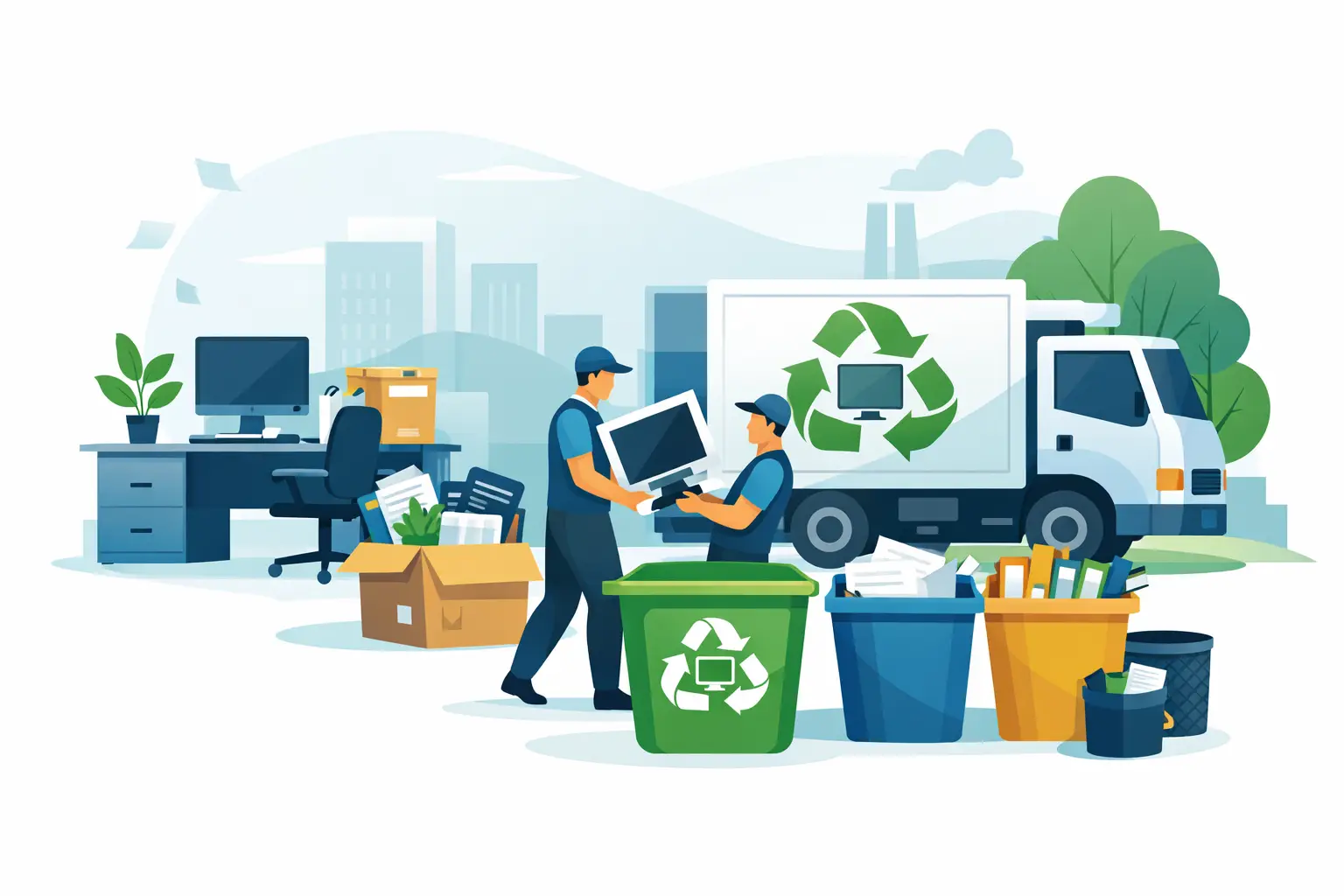
A locked store cupboard full of obsolete laptops, cracked monitors and mystery cables is not just an eyesore. It is a data risk, a compliance issue and a drain on valuable space. That is why free office clearance recycling matters for businesses that need old IT and electrical equipment removed properly, without adding cost or complexity.
For many organisations, the problem builds slowly. A few desktops are replaced, then a bank of screens, then old mobile phones get dropped in a drawer for “later”. Before long, equipment that should have been processed months ago is still sitting on site. The longer it stays there, the more likely it is that sensitive data, asset tracking gaps and poor disposal decisions start to create avoidable risk.
What free office clearance recycling actually means
At its simplest, free office clearance recycling is the collection and responsible processing of unwanted office IT and electrical equipment without a charge for collection, provided the volume and type of items qualify. That can include computers, laptops, monitors, phones, servers, printers, networking kit, cables and other WEEE from office environments.
The word “recycling” can be slightly misleading if it is used too loosely. Good providers do not treat everything as scrap from the outset. The better approach is to follow the waste hierarchy – prioritising reuse, refurbishment and redeployment where possible, then recycling materials only when equipment is genuinely beyond further use. That matters because destroying usable equipment too early is wasteful, unnecessary and often environmentally damaging.
For businesses, the real value is not simply that items leave the premises. It is that they leave through a documented, secure and compliant process.
Why businesses look for free office clearance recycling
Cost is obviously part of the appeal. If you are managing an office move, a tech refresh or a clear-out of long-stored equipment, disposal charges can quickly become another line item in an already stretched budget. Free collection removes that barrier and makes it easier to act promptly instead of letting redundant assets pile up.
But cost is rarely the only driver. Most organisations looking for this service are also trying to solve one or more practical problems.
The first is data security. Old devices are rarely truly empty. Laptops, PCs, smartphones, hard drives and even multifunction printers can retain confidential information. If that equipment leaves your control without proper data destruction, your organisation may be exposed to GDPR breaches, reputational damage and internal governance failures.
The second is compliance. Electrical waste cannot simply be mixed in with general waste or handed to an unverified collector. Businesses have a duty to ensure WEEE is handled correctly and transferred through the proper channels. Registration, traceability and documentation are not optional extras when you are disposing of technology assets.
The third is convenience. Internal teams often do not have the time, vehicles or processes to sort, move and dispose of bulky or awkward equipment. Facilities managers, office administrators and IT teams need a service that gets the job done efficiently, with minimal disruption.
Free does not mean informal
This is where businesses need to be careful. A free service can be excellent value, but only if it is backed by professional standards. If a collector cannot explain how equipment will be tracked, how data will be destroyed, what documentation will be issued or where the material will end up, the fact that the collection is free should not reassure you.
A proper office clearance service should be able to demonstrate lawful operation and clear processes. In the UK, that usually means checking whether the provider is appropriately registered, whether they can support GDPR-compliant data destruction, and whether they can issue the paperwork your organisation may need for audit or internal records.
It also helps to ask how they handle reusable equipment. If everything is automatically shredded or scrapped, that may be easy for the processor, but it is not always the best environmental outcome. A refurbishment-first model is often a better sign that the provider takes both compliance and sustainability seriously.
What can usually be collected
Most office clearances centre on common IT and electrical waste streams. Desktops, laptops, monitors, docking stations, keyboards, mice, phones, tablets, servers, switches, routers and cabling are typical examples. Some providers can also collect printers, photocopiers and general office electricals, although the exact mix depends on the volume, condition and logistics involved.
There is usually a qualification threshold for free collection. That might relate to quantity, equipment type or resale and recovery value. For example, a larger batch of laptops and monitors is more likely to qualify than a single damaged printer and a bag of mixed leads. That does not mean smaller collections cannot be handled, only that “free” depends on the economics of transport, processing and material recovery.
This is one of those areas where it depends on the job. A straightforward IT clear-out in a ground floor office is different from removing mixed electrical waste from multiple floors with restricted access and tight time windows. A reliable provider will be clear about that from the start.
How the process should work
The best free office clearance recycling services are designed to reduce admin, not create more of it. In practice, the process should begin with a clear assessment of what needs to be removed. That may be done from an asset list, photos or a conversation about item types and quantities.
Once the collection is booked, the equipment should be handled through a secure chain of custody. For businesses with data-bearing devices, that point is critical. It is not enough for assets to be collected and “dealt with later”. There should be a defined process for secure transport, logged intake, data destruction and reporting.
After processing, you should expect documentation that reflects what has happened to your equipment. Depending on the service, that may include collection records, waste transfer documentation, asset reports and certificates of destruction or recycling. For schools, public sector bodies and regulated businesses, those records are often essential.
If confidential paperwork is involved alongside IT assets, some providers can also arrange document shredding as part of a wider clearance. That can be useful during office moves or archive clear-outs where both physical records and old technology need to leave site securely.
Security and sustainability should work together
Some businesses still assume they have to choose between environmental responsibility and risk management. In reality, a strong service should deliver both.
If a device contains sensitive data, secure erasure or certified destruction of the data-bearing component is non-negotiable. But once data has been properly dealt with, the rest of the equipment may still have reuse value. Refurbishment and remarketing of suitable assets keeps equipment in circulation longer, reduces demand for new manufacturing and supports a more responsible approach to WEEE handling.
That balance is important. Full physical destruction of whole devices may feel decisive, but it is often unnecessary where secure data sanitisation can achieve the compliance outcome without wasting viable equipment. A provider that understands this distinction is generally better aligned with the circular economy and with the practical needs of modern organisations.
What to check before booking a clearance
Before arranging a collection, it is worth asking a few direct questions. Can the provider handle data-bearing devices securely? Will they issue the documentation your organisation requires? Are they set up to manage office IT and electrical waste compliantly? Do they prioritise reuse before recycling where appropriate?
You should also be realistic about your own site requirements. If access is restricted, if collections need to happen outside core hours, or if assets are spread across different departments, say so early. Clear information at the start usually leads to a smoother collection and fewer surprises on the day.
For organisations with regular equipment turnover, it can make sense to treat office clearance as an ongoing asset disposal process rather than a one-off clean-up. That helps prevent storage areas becoming dumping grounds and keeps retired devices moving through the correct channels sooner.
Tech Recycle’s approach reflects that practical reality – secure collection, compliant handling and a strong preference for refurbishment and reuse wherever possible.
Free office clearance recycling works best when it removes three problems at once: clutter, compliance pressure and uncertainty about what happens next. If your old equipment is still taking up space, now is usually the right time to move it on properly rather than wait for it to become a bigger risk.